First observation of the decay $D_{s1}(2460)^{+} \to D_{s}^{*+}\gamma$ and measurement of the branching-fraction ratio $\mathcal{B}[D_{s1}(2460)^{+} \to D_{s}^{*+} \gamma]/\mathcal{B}[D_{s1}(2460)^{+} \to D_{s}^{+} \gamma]$
| Abstract | We report the first observation of the radiative decay $D_{s1}(2460)^{+} \to D_{s}^{*+} \gamma$, with a statistical significance of 16.8 standard deviations. The signal is found in continuum $e^{+}e^{-} \to c\bar{c}$ production using data samples with integrated luminosities of 980~$\mathrm{fb}^{-1}$ and 572~$\mathrm{fb}^{-1}$ collected by the Belle and Belle~II detectors operating at the KEKB and SuperKEKB asymmetric-energy $e^{+}e^{-}$ colliders, respectively. The branching-fraction ratio $\mathcal{B}[D_{s1}(2460)^{+} \to D_{s}^{*+} \gamma]/\mathcal{B}[D_{s1}(2460)^{+} \to D_{s}^{+} \gamma]$ is measured to be $0.70 \pm 0.04 ({\rm stat.}) \pm 0.06 ({\rm syst.)}$. This result helps discriminate between different theoretical models of the internal structure of the $D_{s1}(2460)^{+}$. |
|---|---|
| Tags | Belle Run 1 Run 2 (partial) |
| Working group | Charm |
| Principal authors | @ Yubo Li, Yang Li, Chengping Shen |
| Reference | submitted to PRL |
| Links | arXiv:2611.20531 |
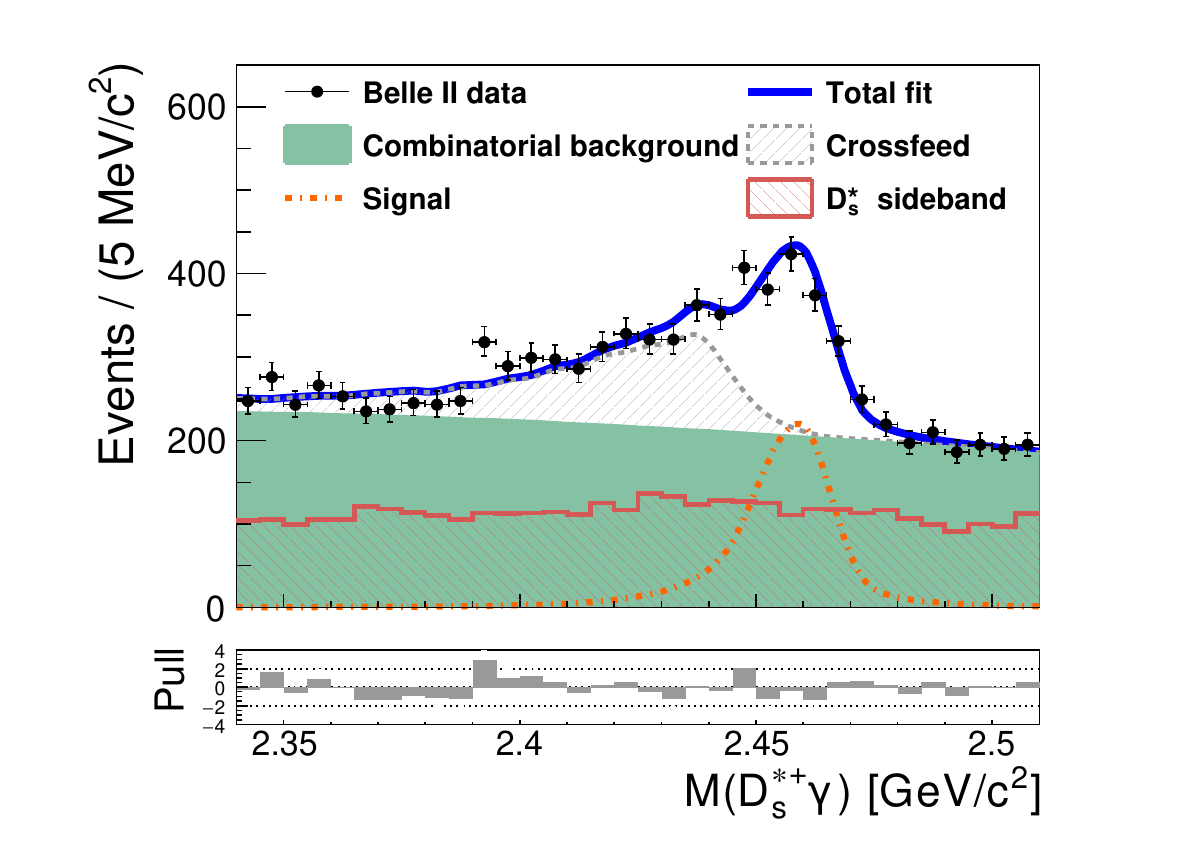
Mass distributions of $M(D_{s}^{*+}\gamma)$ for the reconstructed $D_{s1}(2460)^{+} \to D_{s}^{*+}\gamma$ candidates with fit projections overlaid in (a) Belle and (b) Belle~II data. The data and fit components are indicated in the legends.
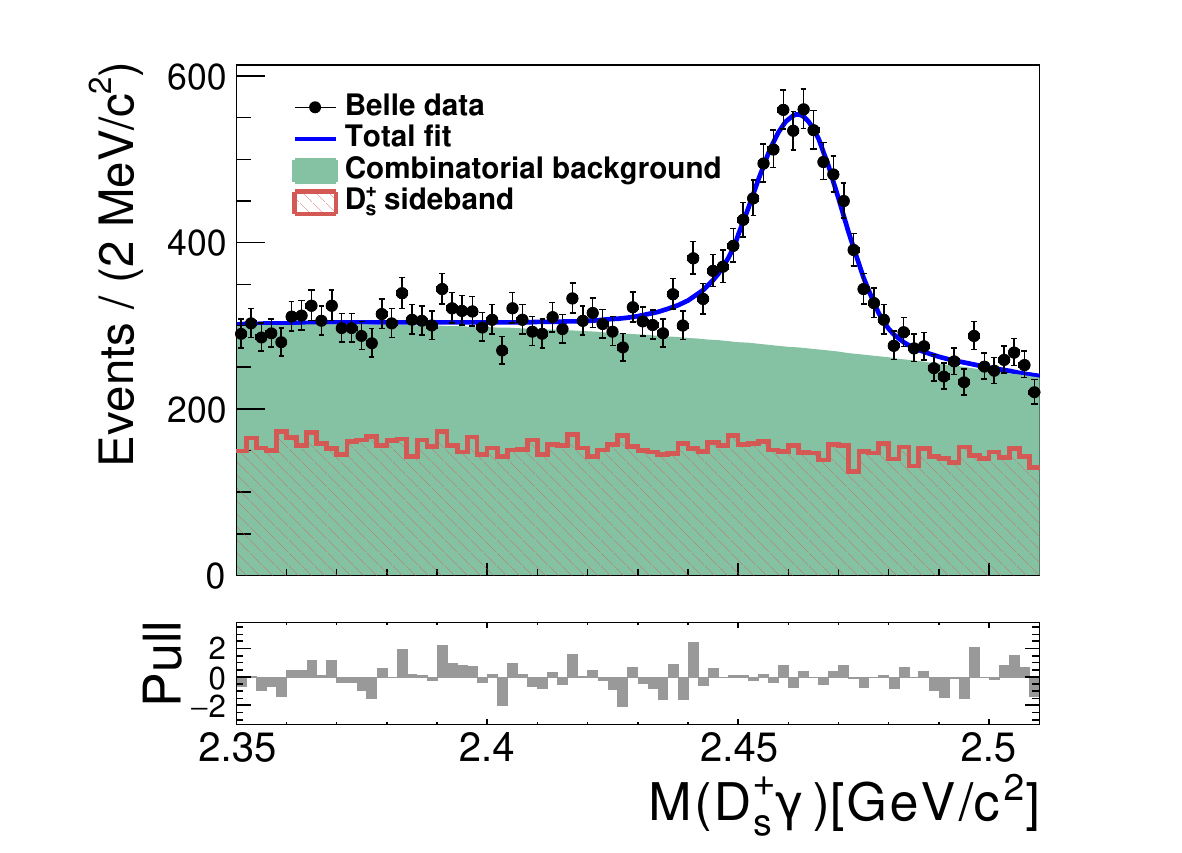
Mass distributions of $M(D_{s}^{+}\gamma)$ for the reconstructed $D_{s1}(2460)^{+} \to D_{s}^{+}\gamma$ candidates with fit projections overlaid in (a) Belle and (b) Belle~II data. The data and fit components are indicated in the legends.
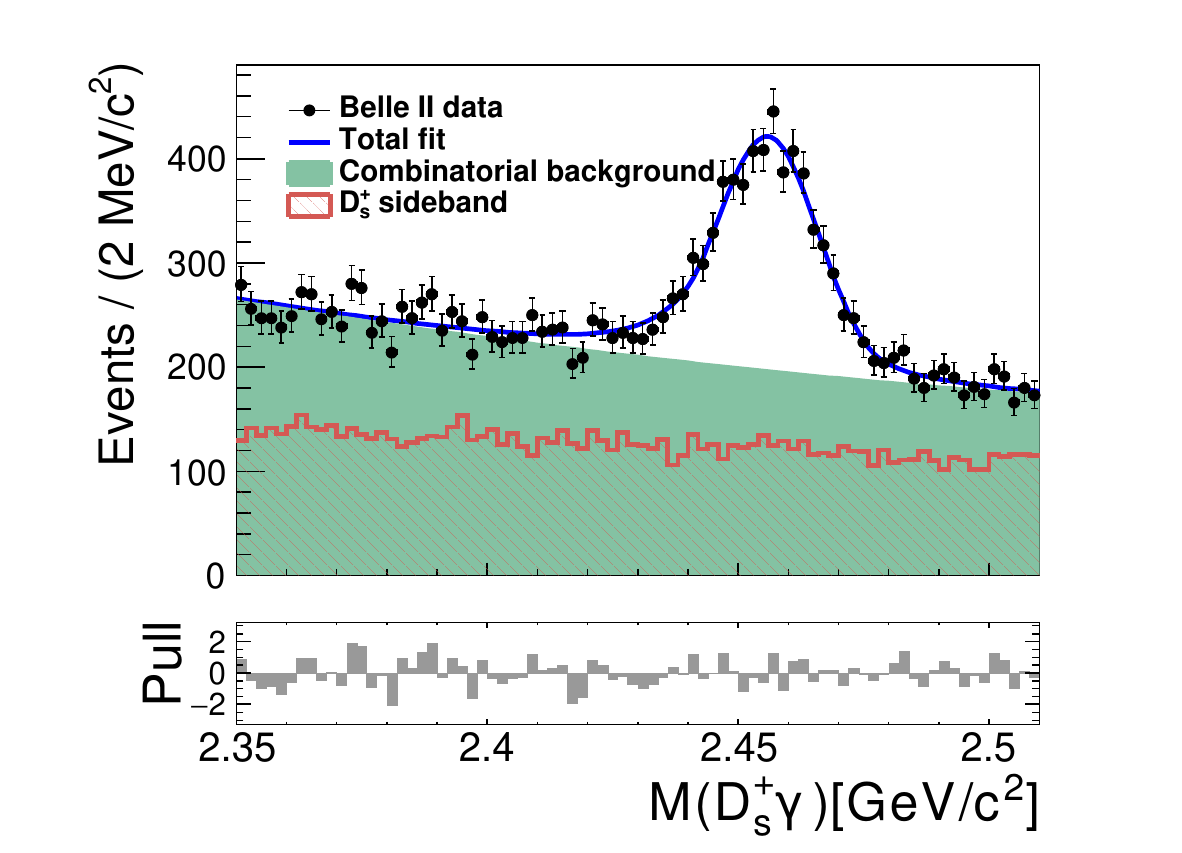
Mass distributions of $M(D_{s}^{+}\gamma)$ for the reconstructed $D_{s1}(2460)^{+} \to D_{s}^{+}\gamma$ candidates with fit projections overlaid in (a) Belle and (b) Belle~II data. The data and fit components are indicated in the legends.
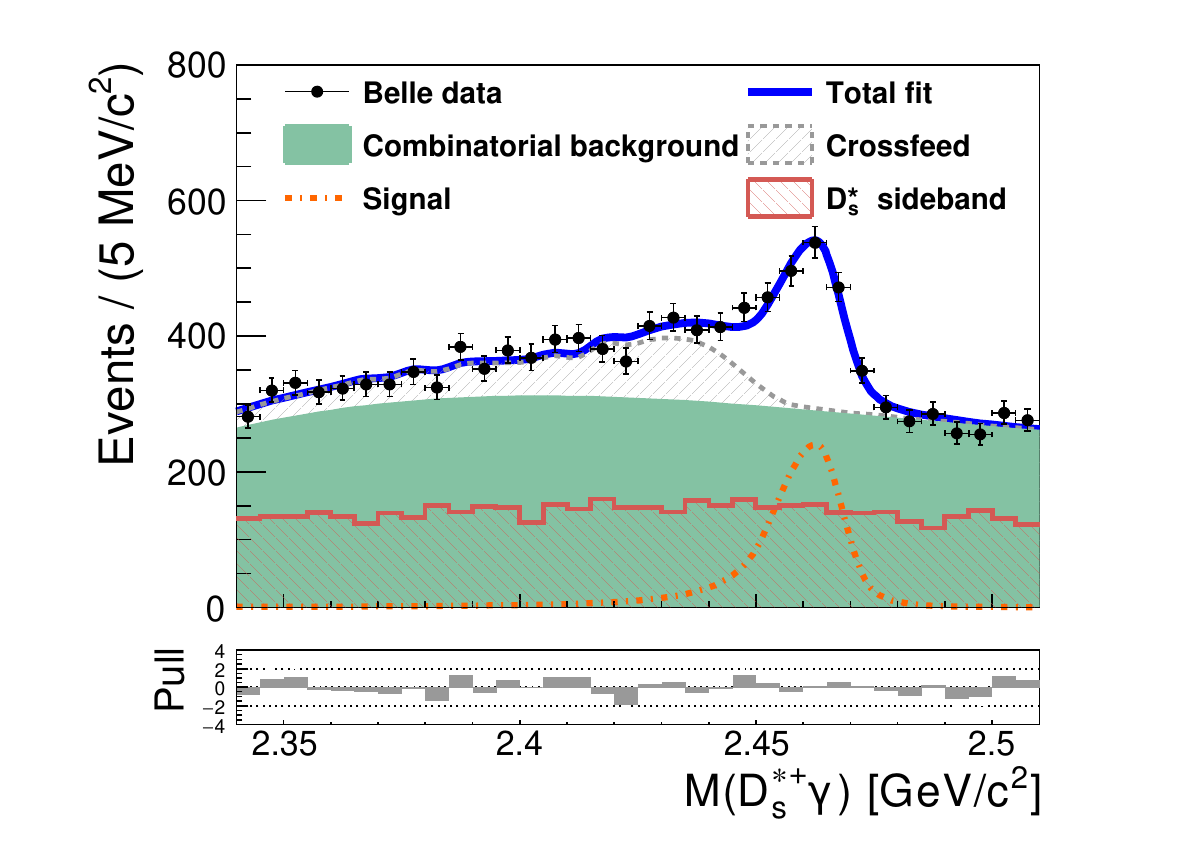
Mass distributions of $M(D_{s}^{*+}\gamma)$ for the reconstructed $D_{s1}(2460)^{+} \to D_{s}^{*+}\gamma$ candidates with fit projections overlaid in (a) Belle and (b) Belle~II data. The data and fit components are indicated in the legends.
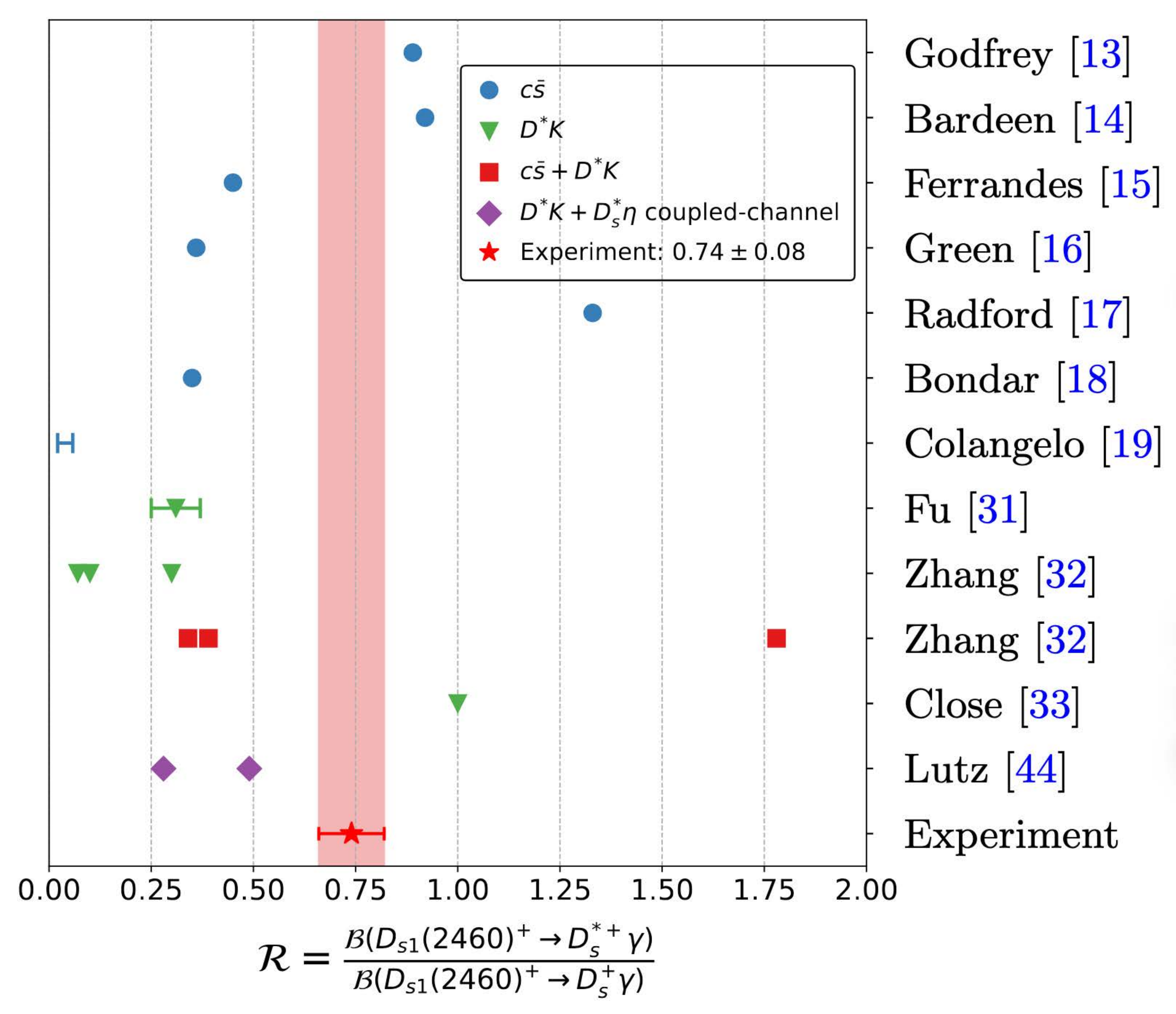
Comparison of the measured $\mathcal{R}$ value with various theoretical predictions. For a conventional $c\bar{s}$ interpretation of the $D_{s1}(2460)^{+}$, the predictions are obtained from quark models by Godfrey~\cite{Godfrey:2003kg}, Green~\cite{Green:2016occ}, and Radford~\cite{Radford:2009bs}; a heavy-light chiral effective theory by Bardeen~\cite{Bardeen:2003kt}; heavy-quark effective theory combined with chiral perturbation theory by Ferrandes~\cite{Ferrandes:2004aa}; a treatment of ${}^{1}P_{1}$--${}^{3}P_{1}$ mixing by Bondar~\cite{Bondar:2025qzg}; and light-cone QCD sum rules by Colangelo~\cite{Colangelo:2005hv}, with the shown $\mathcal{R}$ range inferred from the quoted radiative-width ranges. Predictions beyond the conventional $c\bar{s}$ picture include a $D^{*}K$ molecular description within effective field theory by Fu~\cite{Fu:2021wde}; $D^{*}K$ molecular and mixed $c\bar{s}$--$D^{*}K$ configurations in an unquenched quark model by Zhang~\cite{Zhang:2024usz}; a $D^*K$ molecular scenario considered by Close~\cite{Close:2005se}; and a dynamically generated $D^{*}K$--$D_s^{*}\eta$ state within a chiral coupled-channel framework by Lutz~\cite{Lutz:2007sk}. For each of the two configurations considered by Zhang~\cite{Zhang:2024usz}, the three predicted values correspond to the cutoff parameter $\Lambda_{0}=0.5$, $1.0$, and $1.5~\mathrm{GeV}$. For Lutz~\cite{Lutz:2007sk}, the two predicted values arise from the two possible sign choices of the electromagnetic coupling $e_{A}$ governing light-vector-meson radiative transitions.