Search for $\Xi^0p$, $\Omega^- p$ and $\Omega^- n$ bound states from $\Upsilon(1,2S)$ decay at Belle
| Abstract | We search for $\Xi^0p$, $\Omega^-p$, and $\Omega^-n$ dibaryon states in $\Upsilon(1S)$ and $\Upsilon(2S)$ decays, probing mass regions near the corresponding baryon-baryon thresholds. Multistrange baryon-baryon interactions, relevant to neutron-star matter, remain largely unconstrained, and indications of attractive $\Xi N$ and $\Omega N$ interactions motivate searches for weakly bound states. We use samples of $102$ million $\Upsilon(1S)$ and $158$ million $\Upsilon(2S)$ decays collected with the Belle detector at the KEK asymmetric-energy $e^+e^-$ collider. No significant signals are observed, and we set the first $90$\% confidence-level upper limits on the branching fractions of $\Upsilon(1S)$ and $\Upsilon(2S)$ decays to $\Xi^0p$, $\Omega^-p$ and $\Omega^-n$ dibaryon states, at the level of $\mathcal{O}(10^{-7})$--$\mathcal{O}(10^{-5})$ depending on the channel and assumed binding energy. |
|---|---|
| Tags | Belle |
| Working group | Quarkonium |
| Principal authors | @ Makoto Uchida |
| Reference | submitted to PRL |
| Links | arXiv:2605.29778 |
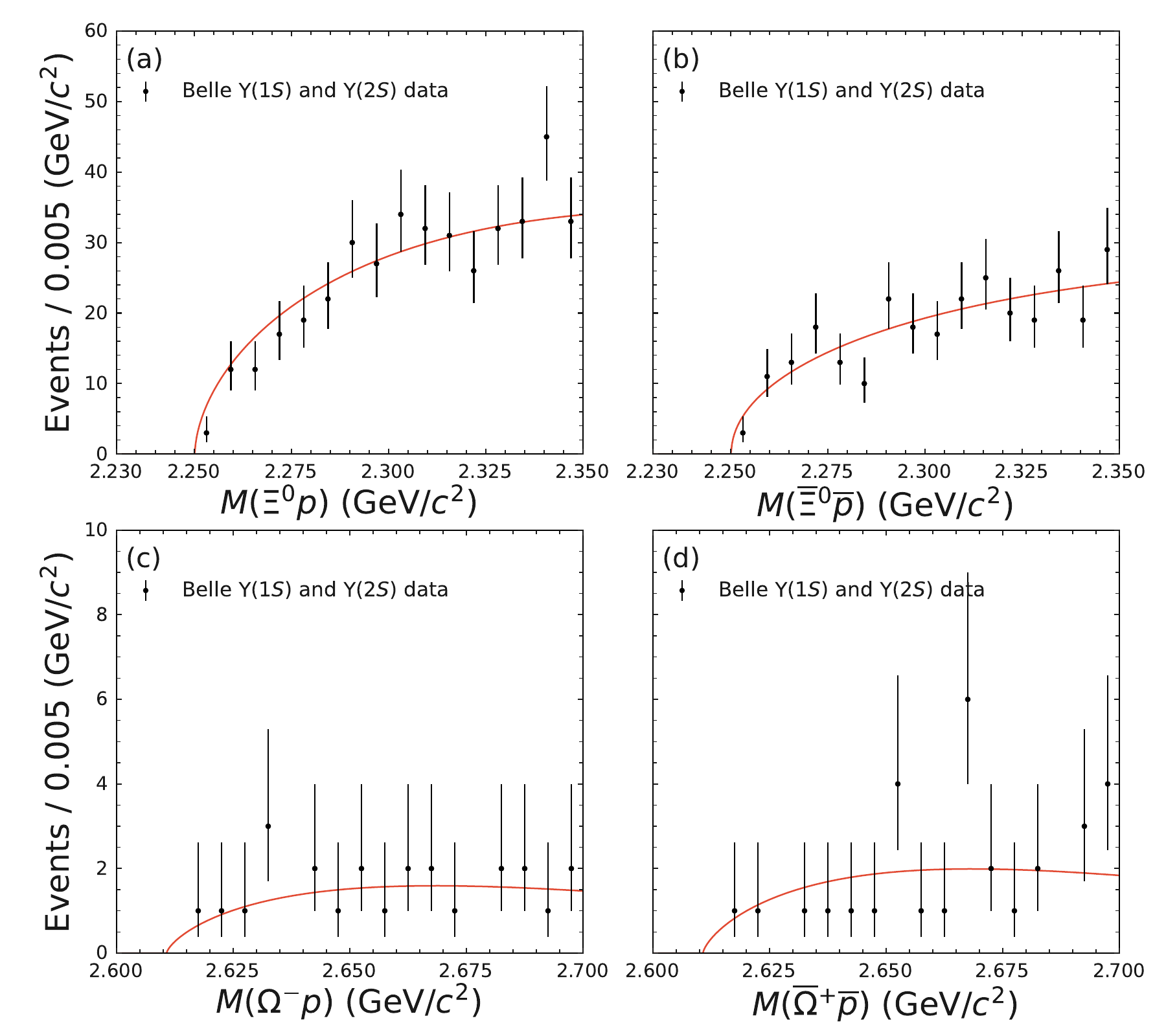
Invariant-mass spectra of unbound hypotheses for the (left column) baryon and (right column) anti-baryon channels, (a) $(\Xi^0 p) \to \Xi^0 p$, (b) $\overline{(\Xi^0 p)} \to \overlin{\Xi}^0 \overline{p}$, (c) $(\Omega^- p) \to \Omega^- p$, and (d) $\overline{(\Omega^- p)} \to \overline{\Omega}^+ \overline{p}$. Data include both \Y1S and \Y2S samples and charge-conjugate decays. Fit results with a background component are overlaid as red curves.
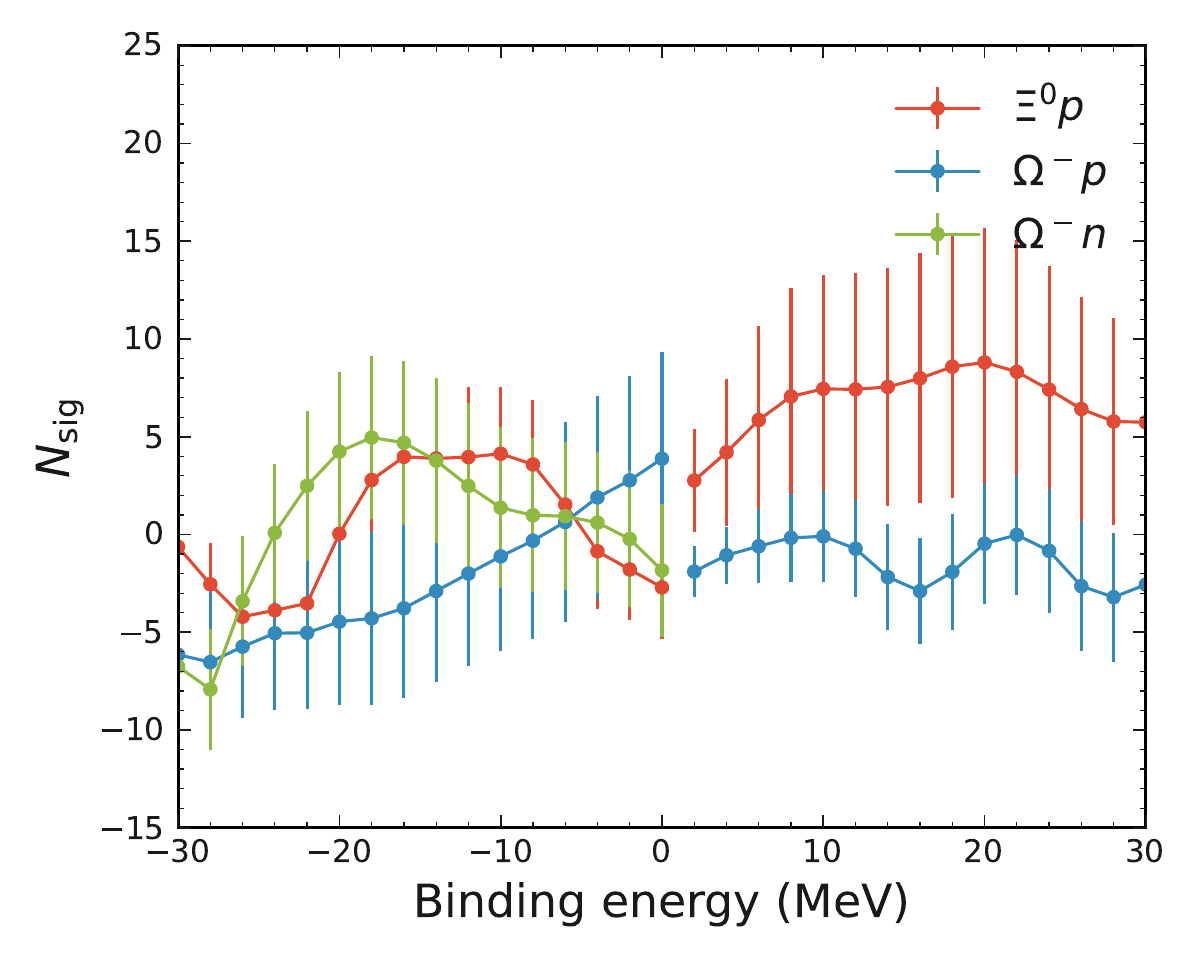
Best-fit estimates of the number of signal events as a function of the binding energy.
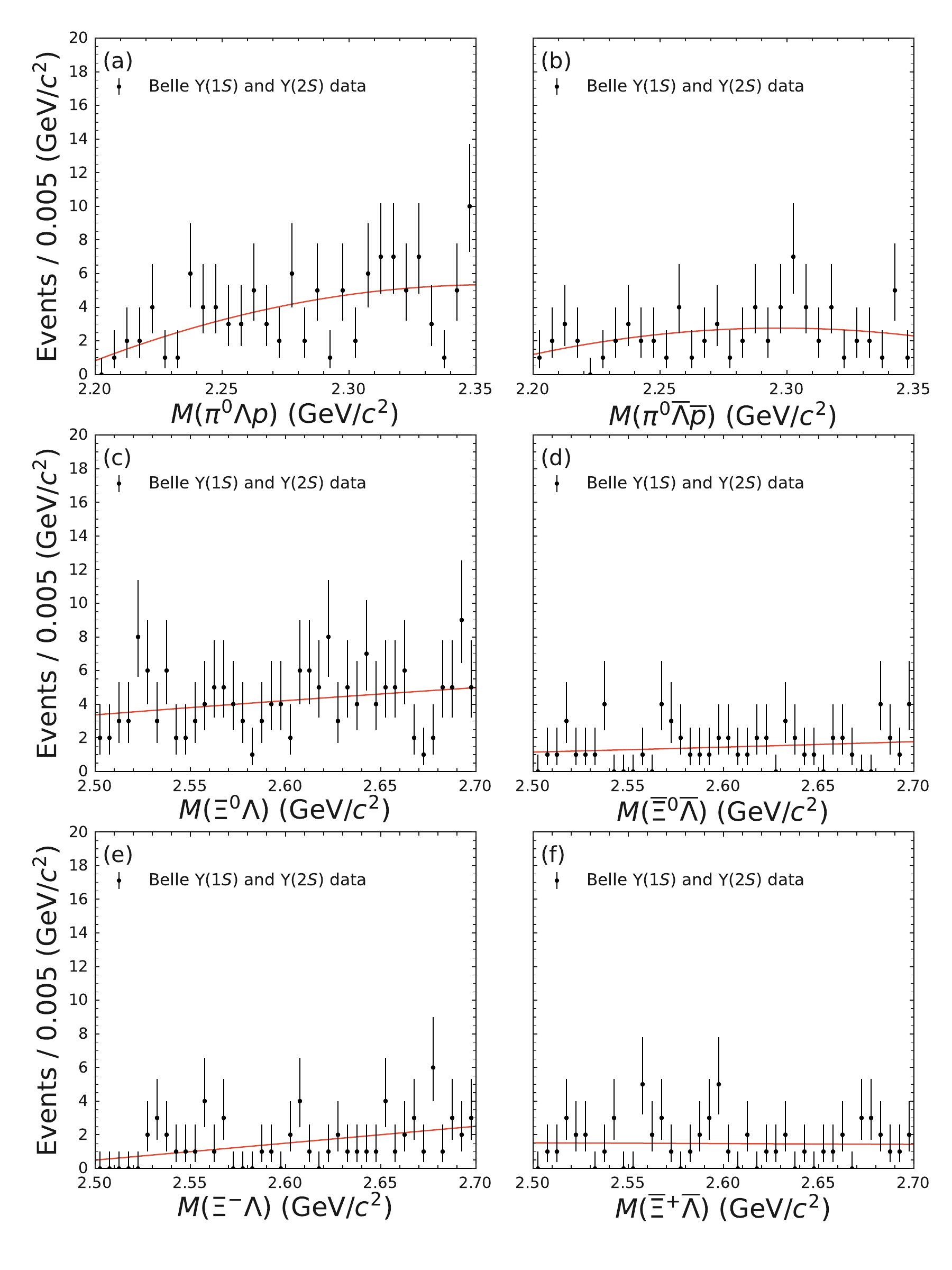
Invariant-mass spectra of bound state hypotheses for the (left column) baryon and (right column) anti-baryon channels, (a) $(\Xi^0 p) \to \pi^0 \Lambda p$, (b) $\overline{(\Xi^0 p)} \to \pi^0 \overline{\Lambda} \overline{p}$, (c) $(\Omega^- p) \to \Xi^0 \Lambda$, (d) $\overline{(\Omega^- p)} \to \overline{\Xi}^0 \overline{\Lambda}$, (e) $(\Omega^- n) \to \Xi^- \Lambda$ and (f) $\overline{(\Omega^- n)} \to \overline{\Xi}^+ \overline{\Lambda}$ and Data include both \Y1S and \Y2S samples and charge-conjugate decays. Fit results with a background component are overlaid as red curves.
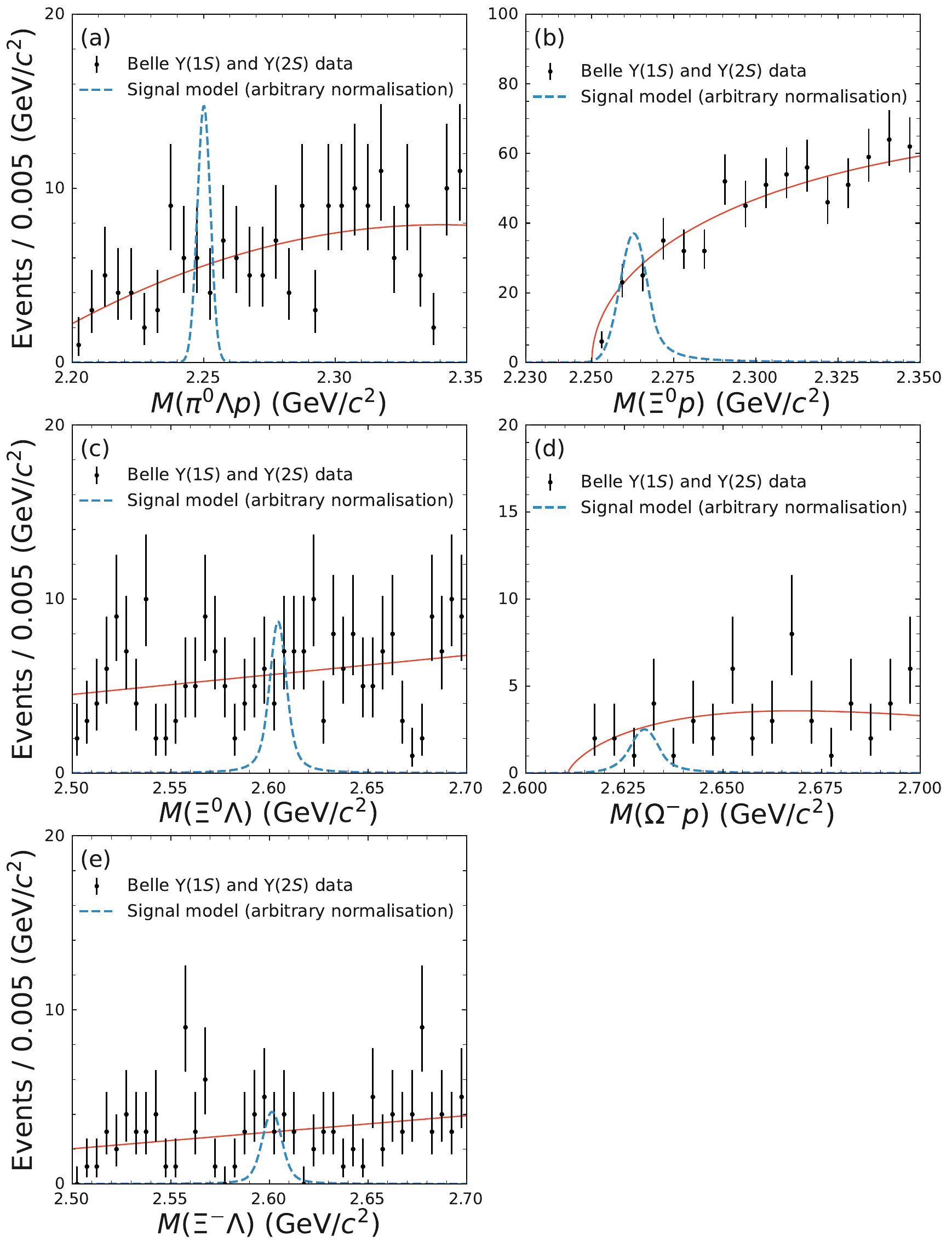
Invariant-mass spectra for the (left column) bound-state and (right column) unbound-state hypotheses, (a) $(\Xi^0 p) \to \pi^0 \Lambda p$, (b) $(\Xi^0 p) \to \Xi^0 p$, (c) $(\Omega^- p) \to \Xi^0 \Lambda$, (d) $(\Omega^- p) \to \Omega^- p$, and (e) $(\Omega^- n) \to \Xi^- \Lambda$. Data include both \Y1S and \Y2S samples and charge-conjugate decays. Fit results with a background component are overlaid as red curves. Blue dashed curves indicate the signal component determined from simulated signal samples.
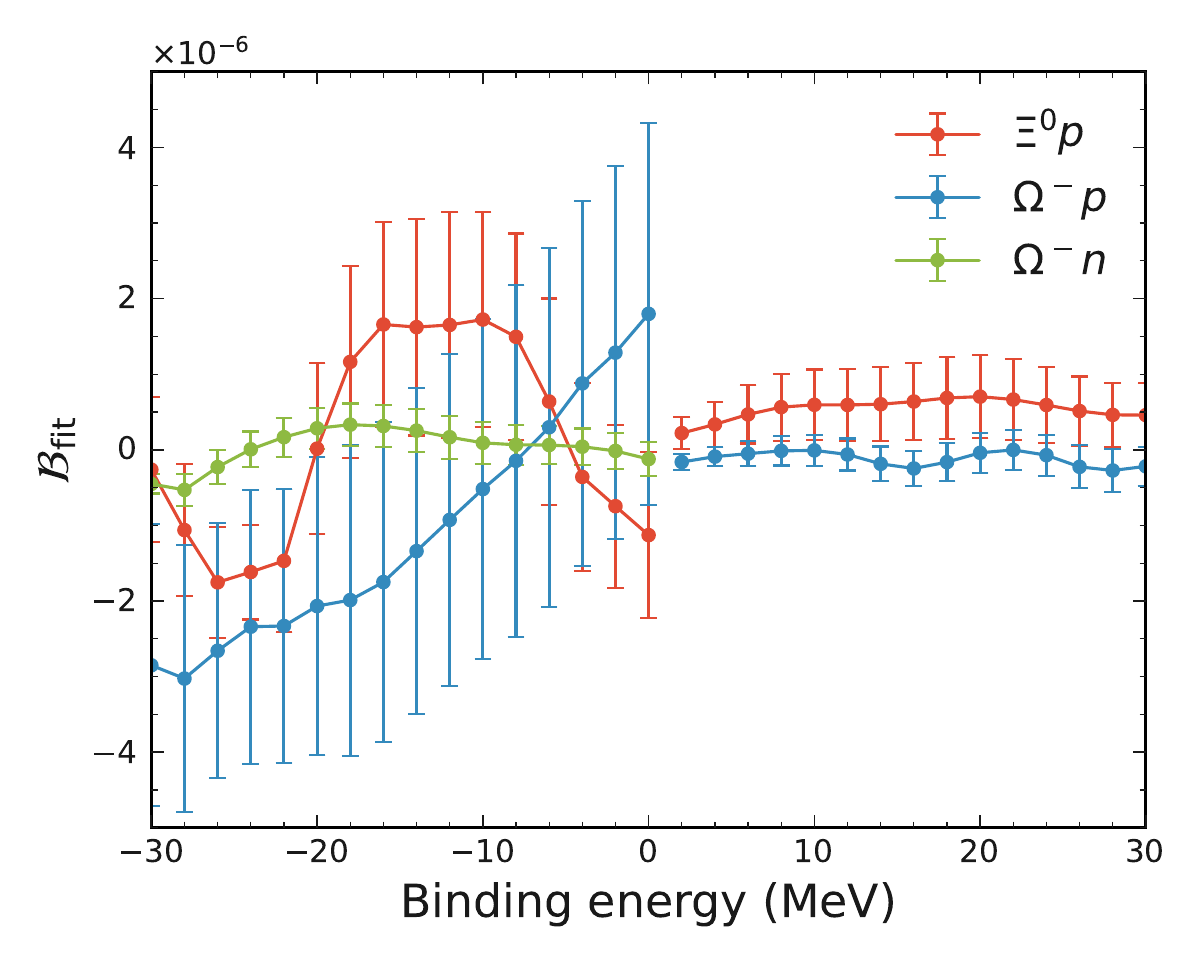
Best-fit branching fractions of $\Y1S$ and $\Y2S$ decays to $\Xi^0p$, $\Omega^-p$ and $\Omega^-n$ dibaryon states as a function of the binding energy for all analysis channels.
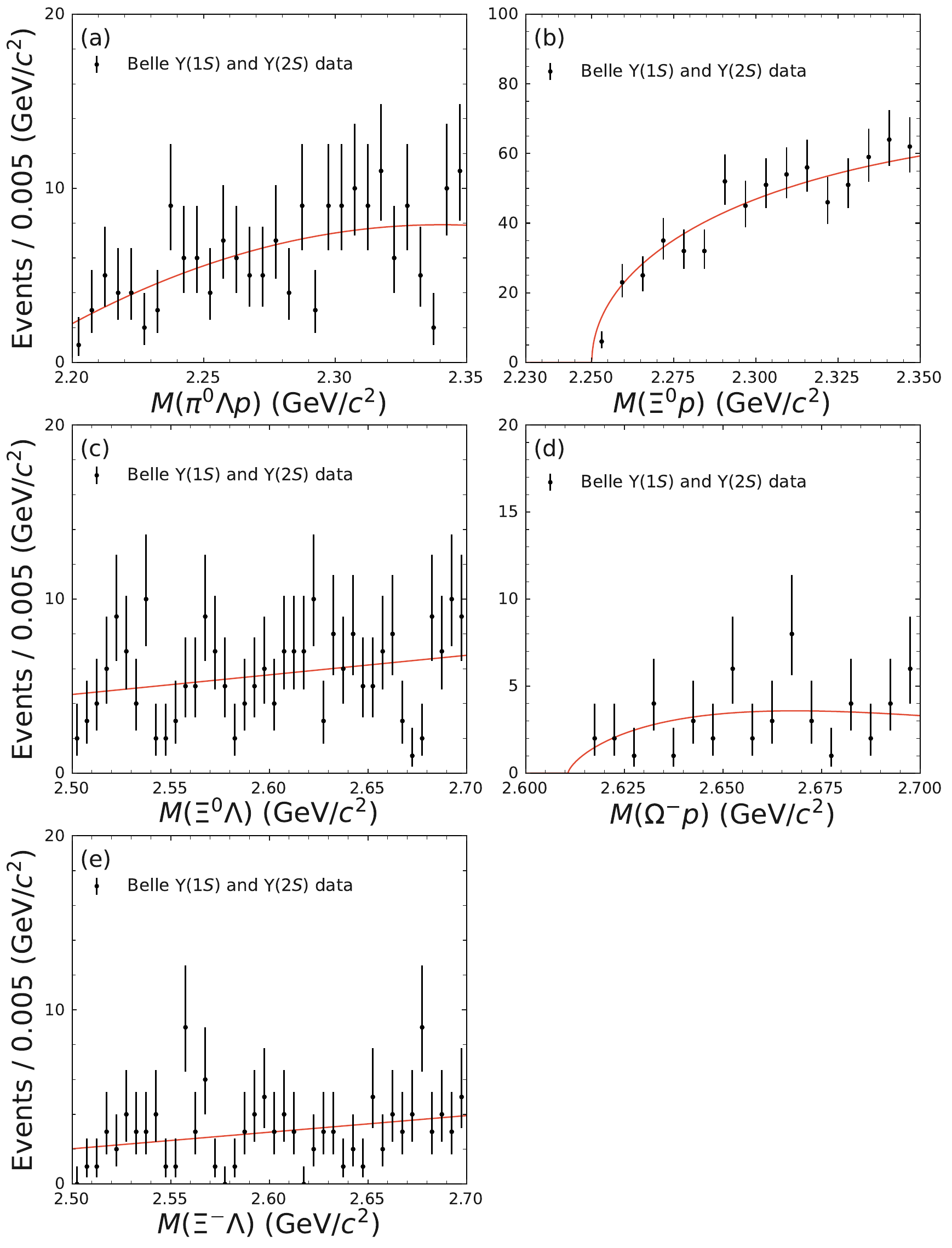
Invariant-mass spectra for the (left column) bound-state and (right column) unbound-state hypotheses, (a) $(\Xi^0 p) \to \pi^0 \Lambda p$, (b) $(\Xi^0 p) \to \Xi^0 p$, (c) $(\Omega^- p) \to \Xi^0 \Lambda$, (d) $(\Omega^- p) \to \Omega^- p$, and (e) $(\Omega^- n) \to \Xi^- \Lambda$. Data include both \Y1S and \Y2S samples and charge-conjugate decays. Fit results with a background component are overlaid as red curves.
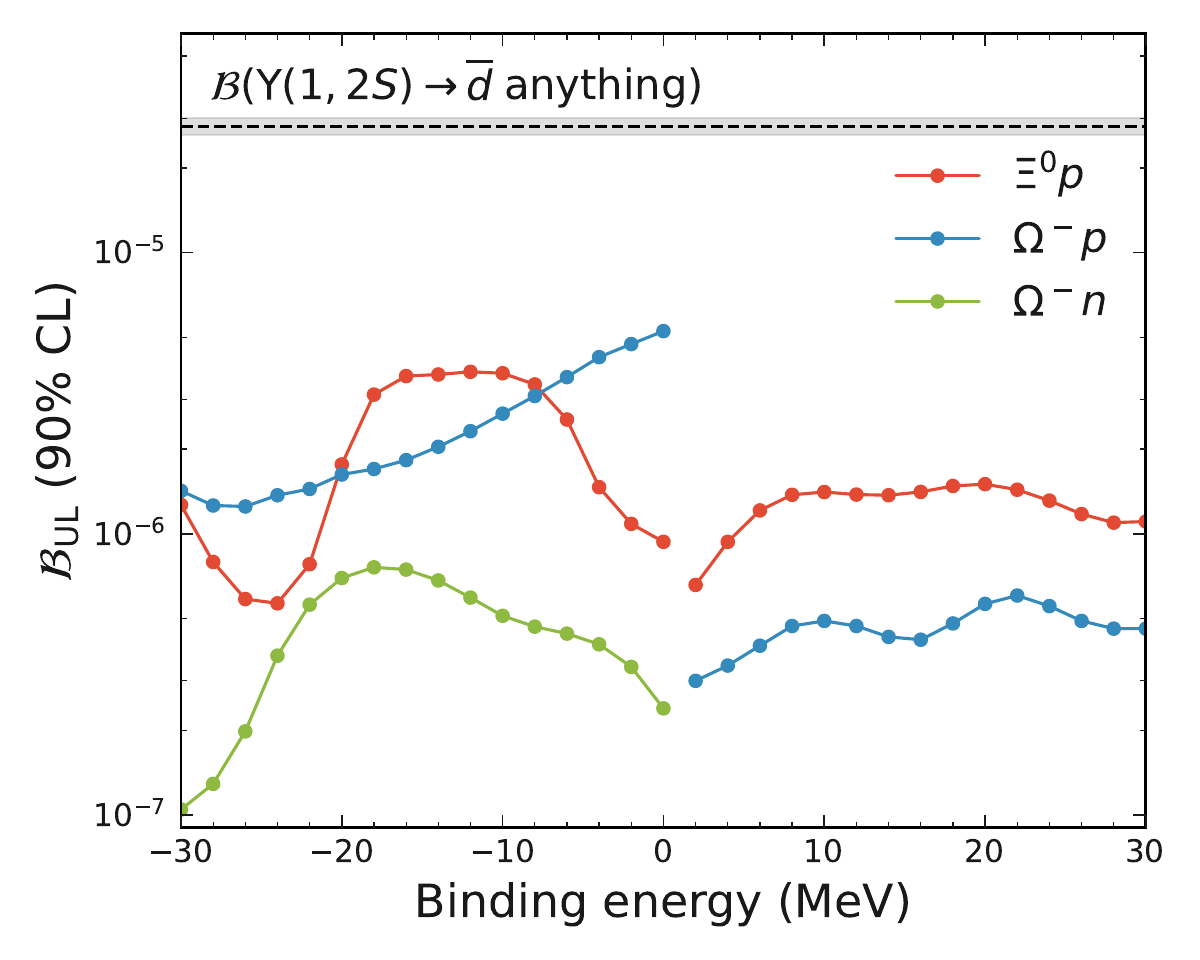
Upper limits at $90$\% confidence level as a function of the binding energy for $\Xi^0 p$ (red), $\Omega^- p$ (blue), and $\Omega^- n$ (green). An average value of the branching fraction for antideuteron~($\overline{d}$) production in $\Upsilon(1S)$ and $\Upsilon(2S)$ decays is indicated by the horizontal dashed line with the shaded band.
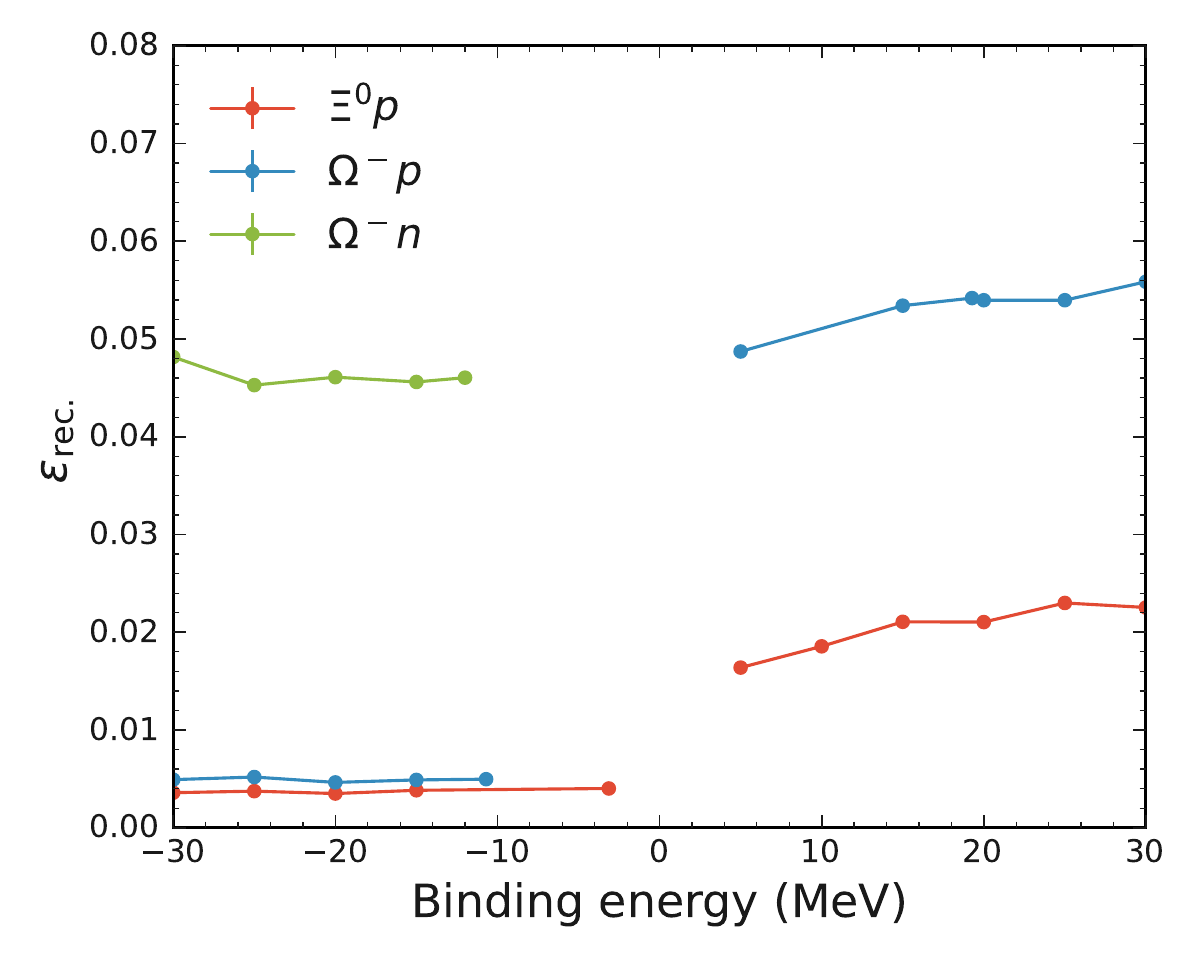
Efficiencies as a function of binding energy for all channels.